
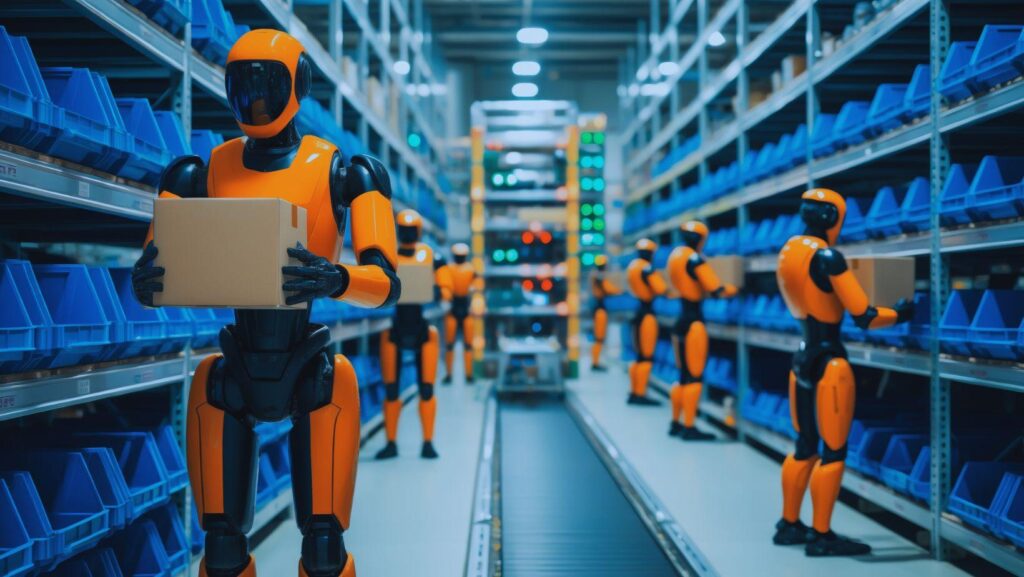
Warehouses have traditionally been viewed as places where products wait. Goods arrive, workers store them, orders come in, and those same products eventually move back out again. Behind that seemingly simple process, however, sits an enormous amount of coordination. Every item must be received, counted, located, picked, packed, and shipped with as few mistakes as possible.
Artificial intelligence is changing nearly every part of that process.
Instead of relying only on fixed rules, historical averages, and manual decision-making, warehouses are increasingly using technology capable of interpreting large amounts of operational data in real time. Computer vision can identify products and monitor movement. Predictive models can anticipate inventory needs. Robots can help move goods through facilities. AI-assisted warehouse management systems can continuously recommend better ways to organize work.
The result is not necessarily a warehouse with no people in it. More often, it is a warehouse where people, software, sensors, and machines work together differently than they did even a decade ago.
Computer Vision Is Giving Warehouses Better Eyes
One of the biggest challenges inside any warehouse is maintaining an accurate picture of what is actually happening.
Traditional inventory systems depend heavily on barcodes, scans, manual counts, and workers following established procedures. Those tools remain important, but computer vision adds another layer of visibility.
Cameras equipped with image-recognition software can identify packages, pallets, labels, and sometimes individual products as they move through a facility. The technology can help detect whether the wrong item was placed in a storage location or whether a package appears damaged before it reaches the customer.
Computer vision can also support safety monitoring. Systems may identify blocked aisles, incorrectly stacked goods, or traffic patterns involving forklifts and other equipment. Rather than relying entirely on occasional inspections, warehouse managers gain an additional source of continuous operational information.
The larger benefit is data quality. AI is only useful when it receives accurate information, and computer vision can help warehouses capture information that would otherwise require workers to manually record it.
Inventory Management Is Becoming Predictive
Knowing how much inventory is currently available is one problem. Knowing how much will be needed next week is considerably harder.
Warehouses have always used historical sales information to help determine stocking levels, but AI allows companies to evaluate much larger combinations of variables.
Demand forecasting systems may consider sales history, seasonality, promotions, regional demand, supplier performance, shipping times, weather patterns, and changing customer behavior. The objective is to identify inventory needs before shortages or excess stock become obvious.
For retailers, this can mean preparing fulfillment centers for seasonal spikes without filling every available shelf with merchandise that may not sell. Manufacturers can use similar systems to anticipate demand for components and raw materials.
The technology is especially useful when thousands of products behave differently. A warehouse manager cannot personally analyze every item every day. Predictive systems can continuously look for unusual patterns and draw attention to inventory that deserves human review.
AI does not eliminate uncertainty. Forecasts can still be wrong when an unexpected event radically changes demand. What it does offer is the ability to respond to changing information more quickly.
Robots Are Becoming Part of Everyday Warehouse Work
Warehouse robotics once brought to mind large industrial machines operating behind protective barriers. Modern warehouse robots often look very different.
Autonomous mobile robots can travel through fulfillment centers carrying shelves, containers, or individual orders. Instead of having employees walk several miles during a shift searching for products, robots can bring inventory closer to designated picking stations.
Other machines assist with sorting, pallet movement, unloading, packing, and repetitive picking tasks.
AI has made these systems more adaptable. Rather than following only fixed paths painted on the floor, some warehouse robots can interpret their surroundings, avoid obstacles, and calculate alternative routes.
That flexibility matters because warehouses are constantly changing environments. Workers move equipment. New pallets arrive. Temporary storage areas appear. Orders shift throughout the day.
The most useful systems are therefore not simply automated. They are capable of responding to changing conditions without requiring every movement to be programmed in advance.
Automated Picking Is Tackling One of the Hardest Problems
Picking products from shelves may sound simple until the enormous variety of objects inside a warehouse is considered.
A machine handling identical cardboard boxes has a relatively straightforward job. A system picking everything from clothing and automotive components to irregularly shaped consumer products faces a much harder challenge.
Modern robotic picking systems combine cameras, sensors, machine learning, and increasingly sophisticated robotic grippers. The technology helps machines determine where an object is located, how it is positioned, and how it might be picked up without damaging it.
Not every warehouse product is suitable for robotic picking, and people remain better at handling many unpredictable situations. Still, automation is expanding steadily in environments where order volumes are high, and products are relatively standardized.
The goal is often to reduce repetitive work rather than automate an entire warehouse. Employees can concentrate on exceptions, quality control, problem-solving, and tasks requiring more flexibility.
High-Value Inventory Is a Different Challenge
Not every inventory decision is primarily about speed.
Medical devices, specialized electronics, aerospace components, and other high-value products can involve additional requirements around traceability, security, handling, documentation, and distribution. A single missing or incorrectly recorded item may represent a far larger problem than an ordinary retail inventory discrepancy.
Healthcare logistics illustrates the challenge particularly well. Medical-device companies need to know not only how much inventory exists but often where specific products are located and how quickly they can reach healthcare facilities or other destinations.
This is one reason specialized logistics providers increasingly combine sector expertise with modern warehouse technology. A healthcare 3PL can support medical-device storage and distribution while using inventory systems, tracking technologies, and data-driven logistics processes to improve visibility throughout the supply chain.
AI can strengthen those operations by identifying unusual inventory movement, forecasting replenishment requirements, optimizing storage locations, and helping managers anticipate potential shortages.
The important distinction is that sophisticated logistics technology must still operate within the practical requirements of the product being handled. Faster is useful, but accuracy and control can be even more important.
AI Can Decide Where Products Should Be Stored
Warehouse layout decisions have traditionally depended on experience and relatively simple rules.
Fast-moving products might be placed near packing stations. Heavy items might be positioned on lower shelves. Products frequently ordered together could be kept nearby.
AI can make these decisions far more dynamic.
Warehouse management systems can analyze order history and determine which products should occupy the most accessible locations. If buying patterns change, storage recommendations can change with them.
Imagine that two items suddenly begin appearing together in thousands of customer orders. An intelligent system may identify the pattern and recommend storing those products closer together, reducing travel time during picking.
This approach is sometimes known as dynamic slotting.
Instead of treating a warehouse layout as something that is redesigned only occasionally, companies can continuously adjust where inventory is placed according to current demand.
Smart Routing Reduces Unnecessary Movement
Travel time is one of the hidden costs of warehouse operations.
In a large fulfillment center, inefficient routes can result in workers and machines covering enormous unnecessary distances. Multiply a few extra minutes across thousands of orders, and the productivity impact becomes significant.
AI-driven routing systems attempt to solve this problem by determining efficient sequences for picking, replenishment, and material movement.
The calculation can become surprisingly complex. A system may need to consider current order priorities, worker locations, robot availability, congestion, storage locations, shipment deadlines, and the physical layout of the building.
Instead of giving every worker a static picking list, the system can continuously reorganize tasks based on what is happening inside the warehouse.
This also allows operations to respond faster when something changes. If an aisle becomes temporarily unavailable or an urgent shipment enters the system, routes can be recalculated instead of requiring managers to reorganize work manually.
Demand Forecasting Is Connecting Warehouses to the Outside World
Warehouse AI becomes even more powerful when it stops looking only at warehouse data.
Demand is influenced by events happening far beyond the building itself. Marketing campaigns can suddenly increase orders. Weather may affect demand for seasonal products. Manufacturing disruptions can delay replenishment. Consumer trends can cause slow-moving items to become unexpectedly popular.
AI systems can combine external signals with internal sales and inventory data to identify changes earlier.
For automotive companies, this might involve forecasting demand for replacement parts by region. Manufacturers can anticipate component requirements based on expected production schedules. Retailers can distribute inventory between fulfillment centers according to anticipated local demand.
The warehouse therefore becomes less isolated from the wider supply chain. Decisions about storage and fulfillment increasingly reflect information coming from suppliers, transportation networks, sales platforms, and customers.
Warehouse Managers Are Moving From Controllers to Decision Makers
AI-assisted warehouse management does not mean software independently makes every operational decision.
A more realistic shift is that managers receive better recommendations.
Instead of spending large amounts of time gathering data from separate systems, supervisors can receive alerts identifying unusual conditions. Inventory may be running lower than expected. A particular picking area may be developing a bottleneck. Certain products may be occupying valuable space despite limited demand.
AI can highlight those issues, but people still decide how to respond.
That distinction matters because warehouse operations involve tradeoffs that software may not fully understand. A system may identify the mathematically fastest option while a manager recognizes a staffing, supplier, customer, or safety issue that changes the decision.
The strongest implementations therefore tend to treat AI as an operational assistant rather than an unquestionable authority.
Better Technology Does Not Remove Human Pressures
Warehouses can become more efficient while remaining demanding places to work.
Automation may reduce repetitive walking or lifting, but employees can also face pressure from productivity tracking, rapidly changing technology, tight delivery targets, overnight shifts, and increasingly data-driven performance expectations.
Organizations adopting advanced systems still need to consider how those systems affect people. Training becomes important when job responsibilities change, particularly when employees are expected to supervise automated systems or respond to exceptions that software cannot resolve.
Workplace technology also cannot solve broader personal or health problems simply by making tasks more efficient. Someone experiencing serious anxiety alongside substance use, for example, may require specialized professional support rather than workplace productivity tools alone.
The human side of automation matters because warehouses ultimately depend on employees who understand both the technology and the physical operation surrounding it.
The Warehouse Is Becoming an Intelligent Network
The most important change AI is bringing to warehouses may not be any single robot, camera, or forecasting algorithm.
It is the way those technologies increasingly work together.
A computer-vision system can identify inventory movement. A warehouse management platform can update stock records. A forecasting model can predict demand. Software can assign work to employees and robots. Routing tools can determine how those tasks should move through the building.
Each part generates information that can improve the others.
This transforms the warehouse from a collection of separate processes into something closer to an intelligent network that continuously observes conditions and adjusts its operations.
There will still be damaged packages, unexpected demand, supplier delays, mechanical failures, and countless other complications. AI does not make logistics perfectly predictable.
What it does is give warehouses more opportunities to detect problems earlier, allocate resources more intelligently, and respond to change faster.
The warehouse of the future may therefore look less dramatically different than people imagine. There will still be racks, pallets, loading docks, forklifts, workers, and boxes.
The biggest transformation will be happening beneath the surface, where millions of small decisions about inventory, movement, demand, and fulfillment are increasingly being shaped by intelligent systems.