
Every home project eventually throws you a combination you didn’t plan for. Maybe it’s a wooden shelf bracket that needs to grip a metal rail, or a rubber seal that has to hold against ceramic tile. Sometimes it’s a phone case, a garden ornament, or a kid’s toy where two completely different plastics have to stay stuck together through daily handling. Gluing two different materials together isn’t the same job as gluing two pieces of the same wood or the same plastic, because each surface reacts to adhesive in its own way. That mismatch is exactly where most DIY repairs go wrong, and it’s usually not because the glue was bad. It’s because the wrong glue got picked for the job.
Here’s what actually matters when you’re bonding dissimilar materials, so you can choose the right glue the first time instead of guessing and hoping for the best.
Why Dissimilar Materials Are Harder to Bond
Every material absorbs, flexes, and grips adhesive differently. Wood is porous, so it soaks up glue and helps build a mechanical hold. Metal and glass sit at the other end of the scale. They’re smooth and non-porous, so there’s nothing for the glue to sink into except the chemical bond itself. Plastics are their own puzzle. Some take glue well, while others seem to resist almost everything on the shelf.
When you’re joining two different materials, you’re really solving two problems at once rather than one. The adhesive has to perform on both surfaces at the same time, which is why a glue built for wood can fail outright on metal or plastic. That’s the real reason dissimilar bonds come apart more often than same-material joints do.
What to Check Before You Choose a Glue
Before you grab whatever tube is closest in the shed, run through a few practical questions first. How porous is each surface, and will one side pull moisture out of the glue faster than the other? Will the joint flex, twist, or carry weight once it’s dry, because a rigid adhesive on a joint that needs to move will crack sooner rather than later. Does the bond have to survive rain, humidity, or temperature swings, especially if it’s outdoors or somewhere like a bathroom or kitchen? And how much time do you actually have, since some repairs need instant grab while others benefit from a slower cure that lets you reposition things.
Answering these honestly before you start saves you from redoing the whole job in a few weeks.
The Best Glue for Common Material Combinations
Wood to metal comes up constantly, in brackets, fittings, and furniture repairs. A construction adhesive or a strong epoxy tends to work best here, as both grip the wood’s texture while still bonding chemically to the metal.
Plastic to metal is trickier, mainly because plastics vary so much in surface energy. A super glue formulated for plastics handles small, precise jobs quickly. For anything larger or load-bearing, an epoxy is usually the safer bet.
Rubber to wood or rubber to metal shows up in gaskets, seals, and DIY furniture feet, and it needs a flexible adhesive that can move with the rubber instead of peeling away from it. A contact adhesive or a flexible construction adhesive will usually outlast a rigid glue in this kind of joint.
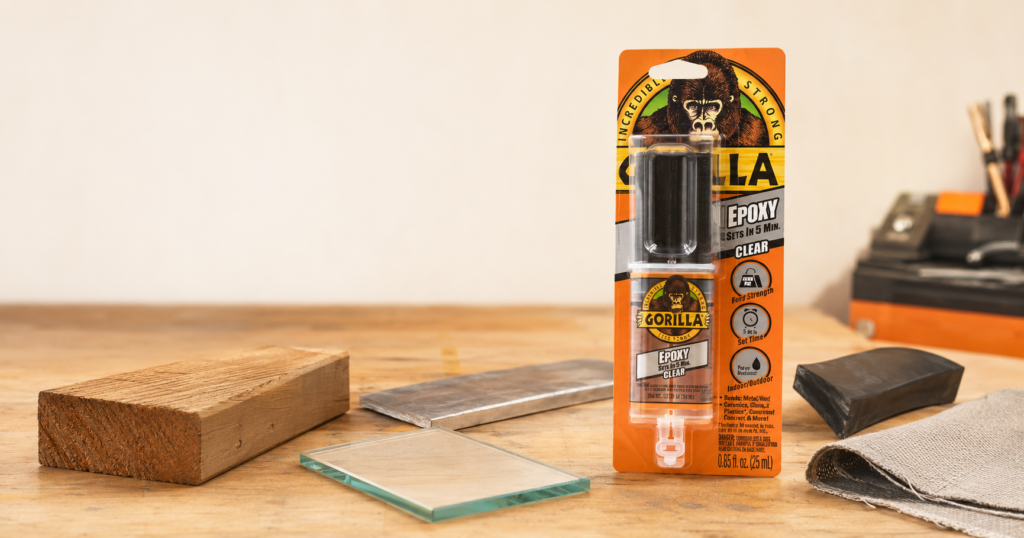
Glass paired with wood or metal needs a clear-drying adhesive that isn’t fussy about porosity. Epoxy is often the safest all-rounder for glass, since its two-part chemical bond sets in minutes and doesn’t rely on either surface being porous.
Fabric to plastic or fabric to wood, common with upholstery repairs, costume props, or outdoor cushions, calls for a flexible fabric glue rather than a rigid adhesive. Rigid glue on fabric tends to crack the first time the material folds or stretches, so it’s worth resisting the urge to reach for whatever’s strongest on paper.
Across all of these combinations, epoxy keeps coming up as the closest thing to a universal answer. That’s because its bond doesn’t depend on porosity the way wood glue or PVA does, so it copes with mismatched surfaces better than most other options. It won’t always be the perfect choice, but when you’re not sure what else to use, it’s rarely the wrong one either.
How to Prep and Apply for a Lasting Bond
Clean both surfaces before anything else. Dust, oil, and old adhesive residue are the number one reason mixed-material bonds fail early, and no glue can fix a dirty joint. Lightly roughen smooth, non-porous surfaces like metal or glass with fine sandpaper so the adhesive has more to grip onto.
Apply the amount the label recommends, because more glue doesn’t mean a stronger bond. It usually just means more mess and a longer wait. Clamp or hold the joint steady while it cures, particularly with dissimilar materials that expand and contract at different rates as the temperature changes. If you can, test the fit dry first, without any glue, so you’re not discovering an alignment problem halfway through a cure that’s already started setting. And always check the label for cure time and any warnings specific to the materials involved, since a five-minute epoxy and an overnight construction adhesive need very different handling.
Choosing Confidently
Gluing dissimilar materials really comes down to understanding each surface, not just reaching for whatever’s already open in the shed. Once you know how porous, flexible, and exposed your materials will be, choosing the right adhesive stops being guesswork and starts being common sense. It’s a five-minute check that can save you an entire afternoon of redoing the same repair.
If you’re still not sure which product suits your particular combination, it’s worth browsing Gorilla Glue’s full range of adhesives, tapes, and sealants to find the one built for the job in front of you.