
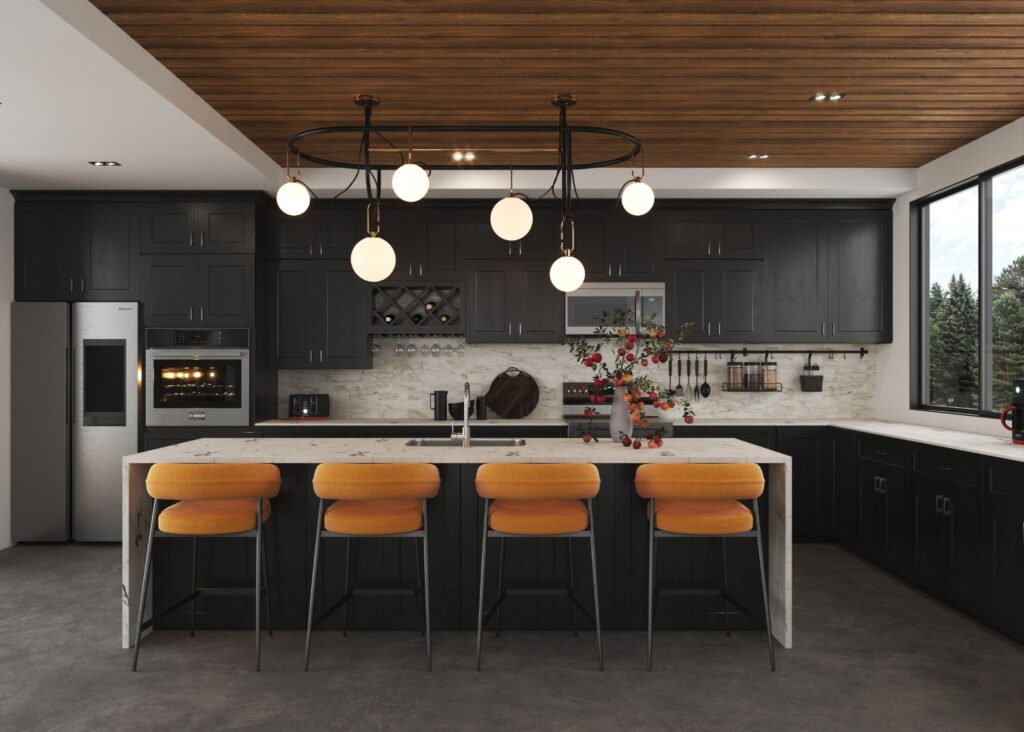
Making a small kitchen look bigger is mostly a perception problem, not a space problem, and that is the good news. A small kitchen really has two separate challenges: capacity, fitting everything in, and perception, how large the room feels to stand in. You can win the storage battle completely and still feel cramped, because feeling cramped is about what the eye sees, not what the cabinets hold. The short version: keep sightlines unbroken, use light recessive colors, flood the room with even light, draw the eye upward, and keep surfaces clear, all of which cost little and move no walls.
The eye judges a room’s size from a handful of cues, light, color, sightlines, and visual continuity, and a small kitchen can be designed to send all of them in the direction of “bigger.” Here is how each one works.
Keep Sightlines Unbroken to Make a Small Kitchen Feel Larger
A room feels larger when the eye can sweep across it without stopping. Every visual break, a contrasting cabinet, a busy backsplash, a band of bold color, acts like a wall the eye bumps into, and a series of those bumps chops a small room into smaller pieces. The trick is continuity. When cabinetry, walls, and counters stay within a related, calm palette, the gaze glides from one surface to the next and reads the whole as a single, larger volume. Perceived openness works alongside real clearance, too: the NKBA planning guidelines recommend at least a 36-inch walkway, and keeping that path clear reinforces the sense of space the palette creates.
This is why a small kitchen done in one quiet color family almost always feels bigger than the same kitchen broken up with strong contrasts, even though the dimensions are identical. You are not adding space; you are removing the visual stops that made the eye perceive less of it.
What Color Makes a Small Kitchen Look Bigger?
Color has a measurable effect on perceived depth. Light, cool tones recede, they appear to sit farther away, which visually pushes a wall back and opens the room. Dark, warm tones do the opposite, advancing toward the viewer and enclosing the space. This is the simple reason light, neutral cabinet finishes are the standard advice for small kitchens: white and pale shaker fronts make the boundaries of the room feel farther apart than they are.
That does not ban dark cabinets from small kitchens, but it does mean using them with intent. A dramatic dark kitchen can be stunning, the move is to control where the darkness sits. A charcoal or black lower run, with light walls and pale uppers above, grounds the room without closing it in, because the recessive light tones still dominate the eye line where it matters. Reflection helps too: a glossy finish, a mirrored or glass backsplash, and polished surfaces bounce light around and add an impression of depth that a flat, matte small kitchen lacks.
Use Lighting to Open Up a Small Kitchen
Nothing makes a small space feel smaller than dimness. A dark kitchen reads as cramped, closed, and older than it is, while a bright one reads as open and current. Light is therefore one of the most powerful and cheapest levers on perceived size.
Maximize the daylight first, keep window treatments minimal so nothing blocks the natural light a small kitchen needs. Then layer in artificial light so there are no dim corners, because shadowed corners visually shrink a room by hiding its boundaries. Under-cabinet lighting earns its place especially here: it washes the counter and backsplash with light, erases the dark cave that forms under wall cabinets, and adds a sense of depth to the whole work surface. A small kitchen lit evenly, corner to corner, simply looks larger than the same kitchen with pooled light and dark gaps.
Cabinet Height and Clear Counters: Two More Space Tricks
Two last cues. The first is verticality, drawing the eye upward makes a room feel taller and therefore larger. Wall cabinets come in standard heights of 30, 36, and 42 inches, and choosing the tallest that fits is what lets you run the cabinetry to the ceiling, reclaiming the dead space standard uppers leave above them so the same move that adds storage also lifts the apparent height of the room. A tall, slim cabinet does the same thing vertically.
The second is the most powerful and the most overlooked: clear surfaces. Clutter is the single biggest enemy of perceived space. A countertop crowded with appliances and odds and ends reads as a small, busy, overwhelmed kitchen no matter how generous the actual footprint. Clear counters read as roomy and calm. This is where capacity and perception finally meet, good storage that gets things off the counters is not just practical, it is the most effective visual enlargement trick there is, because an empty surface is what the eye reads as space.
Frequently asked questions about small kitchens
What color makes a small kitchen look bigger? Light, cool neutrals like white and pale gray. They recede visually, making walls feel farther apart, while dark, warm tones advance and enclose the space, making it feel smaller.
Can I use dark cabinets in a small kitchen? Yes, with intent. Confine the dark tone to a lower run or one section and keep the walls and upper cabinets light, so the recessive light tones still dominate the eye line and the room stays open rather than closed-in.
Does lighting really make a kitchen look bigger? Significantly. Even, shadow-free light makes a small kitchen read as open and current, while dim, pooled light shrinks it by hiding the room’s boundaries. Under-cabinet lighting is one of the most effective additions.
Why does clutter make a kitchen feel small? The eye reads clear surface as space and busy surface as confinement. A cluttered counter makes even a large kitchen feel cramped, which is why storage that keeps counters clear is the most powerful visual enlarger there is.
How does cabinet height affect the sense of space? Running cabinets to the ceiling draws the eye upward, making the room feel taller and larger, while also reclaiming otherwise-wasted space above standard wall cabinets. Vertical lines lift the apparent height of the room.
A small kitchen does not have to feel small. Keep the sightlines unbroken, let light recessive colors push the walls back, flood the room with even light, lift the eye upward, and above all keep the surfaces clear, and a compact footprint reads as open and calm. None of it moves a wall or adds a square foot. It just gives the eye every reason to perceive more room than the tape measure says is there.